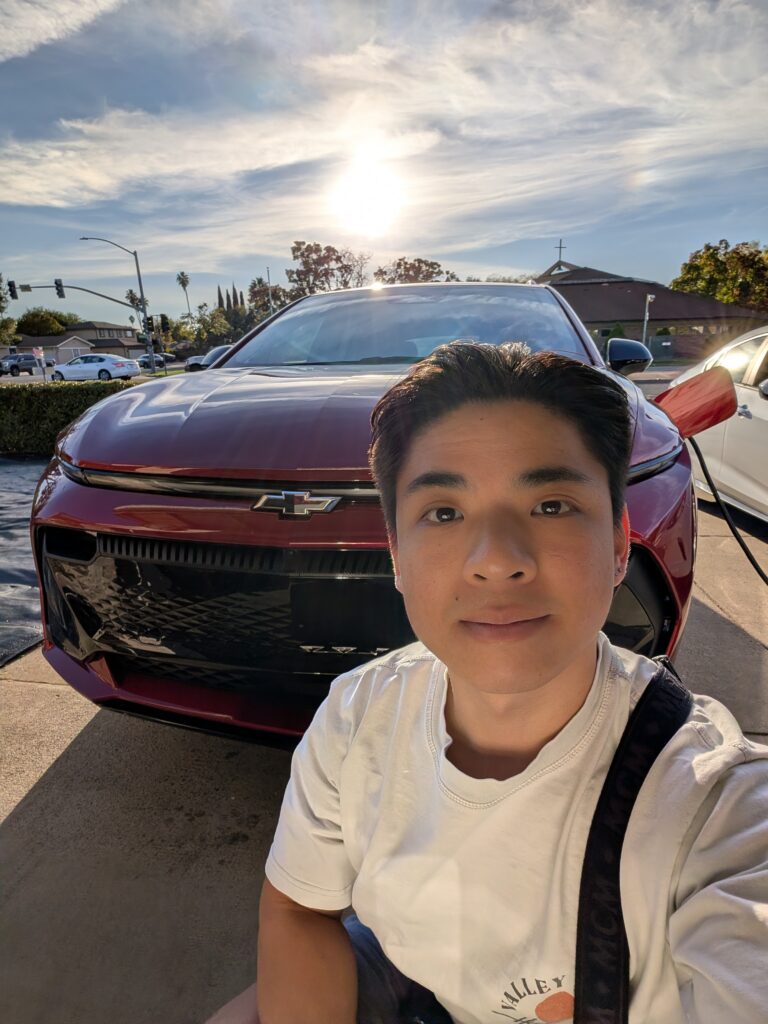
For Jielin, upgrading to an electric vehicle was a major step toward a cleaner, more affordable way to commute — and one he had been thinking about for years.
“I used to drive a 1999 Nissan Pathfinder,” he says. “That car was basically drinking gas, giving me about 10 miles per gallon.” Every fill-up cost him more than $70. Now, with his 2025 Chevrolet Equinox EV, the difference is dramatic. “I’m charging at home, and for roughly 320 miles per charge, I’m only paying about $8.”
The shift hasn’t just saved him money — it’s changed his day-to-day routine. “It’s quiet. It’s comfortable. It’s a new car with a lot of convenience. It don’t smell like gas no more… I don’t have to worry about warming it up. I just go out and drive. It’s like an appliance.”
But Jielin’s connection to DCAP goes back further than most. “I used to sell cars,” he explains. “I knew the program from back then when it was called Clean Cars for All. I saw people come in with the vouchers… and now I got an opportunity to use it.”
When he realized he finally qualified, applying to DCAP felt like the obvious choice. “That’s the main reason,” he says. “I learned about the program and the benefits of it, and I just went for it.”
The process took some patience, but he found the instructions straightforward. “The process — it was kind of long, kind of,” he says. “But the instructions are pretty clear. Just follow what they do.” And while he wishes he could have spoken directly with a case manager, he acknowledges that everything worked as intended. “In the end, it worked out.”
Now, with his new EV, he feels good about both the savings and the environmental impact. “Compared to my gas cars… sometimes I feel bad for the environment, because it’s only giving me like 10 miles per gallon,” he says. “This new car is definitely a lot better.”
His message to anyone thinking about applying is simple:
“Not much — it’s just all benefits. Just do it now. Just do it, like Nike says.”