
Access to reliable transportation can open the door to greater economic opportunities.
This month, we’re spotlighting DCAP’s partnership with MAAC and the shared
commitment to helping eligible San Diego County families access cleaner, more
affordable transportation options.
Read on to learn how this collaboration is helping San Diego families move toward a
cleaner, more affordable future.
1. Can you tell us about MAAC’s mission and the communities you serve?
At MAAC, we believe every person and family deserves the chance to build a stable,
healthy, and hopeful future. Our mission is to maximize self-sufficiency through high-
quality programs and advocacy in our communities. We work across San Diego County
to connect people with programs, resources, and support that help them move forward.
Our work focuses on five core pathways of service: Economic Development, Education,
Health & Well-being, Housing, and Leadership Development & Advocacy. We are
especially committed to supporting low- and moderate-income families, working
households, seniors, immigrants, and others who may face barriers to long-term
stability. By supporting both children and adults with a multi-generational approach,
MAAC helps families grow stronger today and build new opportunities for tomorrow.
2. What transportation challenges do your clients commonly face?
Many of the individuals and families MAAC supports face transportation challenges that
make daily life more difficult. These can include high gas and repair costs, unreliable or
aging vehicles, limited access to public transit, long commutes, and difficulty qualifying
for affordable financing.
Some families are spending a large portion of their income to keep an older vehicle
running. Others may desire to own a safer and more reliable clean energy vehicle but
believe it is out of reach because of cost, credit barriers, or high-interest financing.
MAAC meets families and individuals where they are and helps them find a solution that
works for their needs.
3. How does DCAP align with MAAC’s efforts to help families achieve economic stability
and mobility?
DCAP supports MAAC’s work to help families build stability by making important clean
transportation resources more accessible. The program provides eligible households
with an opportunity to explore cleaner, more reliable vehicle options through state-
funded incentives and application support.
By helping participants better understand their options and take the next step toward
clean transportation, DCAP supports families on their path toward greater economic
mobility, stability, and opportunity.
4. What made MAAC interested in partnering with the Driving Clean Assistance
Program?
MAAC partnered with the Driving Clean Assistance Program (DCAP) because it aligns
closely with our work in economic mobility, financial education, and community resource
navigation. DCAP gives income-qualified households a practical way to explore clean
transportation options along with guidance through the application process.
For MAAC, this partnership is a natural fit because it connects environmental benefits
with real financial relief for families.
5. What benefits can eligible community members gain through programs like DCAP?
Eligible participants can learn more about a state-funded program that helps
households explore cleaner, more reliable vehicle options through financial incentives
and application support. They can learn whether the program may be a good fit for their
household, understand available incentives, and get guidance on the steps needed to
move forward.
Most importantly, community-based partnerships like this give participants an
opportunity to ask questions and connect with trusted organizations so they do not have
to navigate the process alone.
6. Why is hands-on support important when connecting community members to
programs like DCAP?
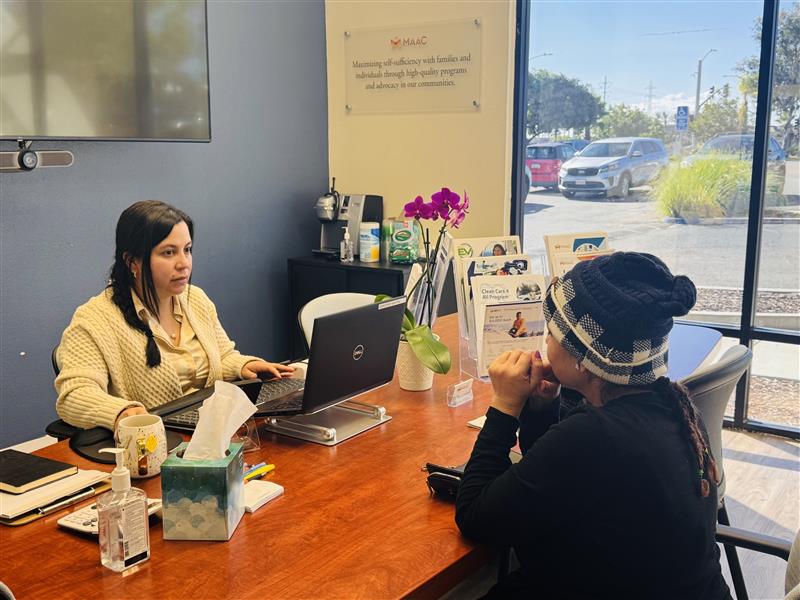
Hands-on support is important because applications can feel overwhelming, especially
when they include eligibility rules, income documents, transportation choices, and
financial information. Community-based support gives individuals the opportunity to ask questions, get help
navigating the process, and feel more confident about their options. Often, the biggest
barrier is not whether someone qualifies is simply not knowing how or where to begin.
7. What would you say to someone who thinks owning a cleaner vehicle may be out of
reach financially?
We encourage community members to come learn about their options before counting
themselves out. Many families assume a cleaner or more reliable vehicle is not
financially possible, but programs like MAAC’s Electric Vehicle Access Program and
DCAP are designed to help make owning a cleaner vehicle more accessible for eligible
households.
If you’re interested in purchasing or leasing an electric vehicle, talk with MAAC staff and
EV Ambassadors—people who have taken the steps to learn about electric vehicles
and ultimately decided to lease or purchase their own EV. Their experiences can help
others better understand what may be possible.
8. Who should consider learning more about DCAP?
Community members who want to learn about cleaner vehicle options, transportation
assistance, or DCAP eligibility should consider learning more about the program. DCAP
may be especially helpful for working families, commuters, households with older or
unreliable vehicles, people facing high fuel or repair costs, and anyone who needs
dependable transportation to get to work, school, appointments, or care for their family.
9. What are you most excited about regarding the partnership between MAAC and
DCAP?
We are especially excited about the opportunity to connect DCAP resources directly
with the communities MAAC serves. Having knowledgeable staff and trusted community
organizations available to answer questions help make the experience more personal,
accessible, and supportive for people who may not know where to begin or whom to
ask.
This partnership brings a practical resource directly to the community in an
approachable way, helping MAAC and DCAP answer questions, meet families where
they are, and support their next step toward reliable, cleaner transportation. It is
meaningful because it connects environmental goals with the everyday needs of
families.
10. Can you share a story or example of how transportation access has helped a client
improve their quality of life?
Peter came to MAAC’s EV Access Program in May 2025, eager to begin his clean-
vehicle journey. At first, the paperwork felt overwhelming, but MAAC staff helped him
gather what he needed to submit his DCAP application.
When the federal Clean Vehicle Credit deadline was moved up to September 30, 2025,
Peter and the MAAC team worked quickly to keep his application moving. On November
5, 2025, he was approved for a $10,000 DCAP grant.
Peter had missed the federal tax credit deadline, but he didn’t give up. The next day, he
bought a 2024 Hyundai Ioniq 5, confident in the support he received and incentives still
available to him. Shortly after his purchase, EV Access staff helped him apply for
additional benefits, including an SDG&E rebate, adding another $4,000 in savings.
Peter later became an EV Ambassador so he could share his experience with others. At
a Ride & Drive event in San Marcos, he spoke with community members about how
MAAC, DCAP, and available incentives helped him secure $14,000 toward his clean-
vehicle purchase.
His story shows how the right support can help make cleaner, more dependable
transportation feel within reach.
11. Where can readers learn more about MAAC’s services and upcoming community
events?
Readers can learn more at MAACproject.org, by emailing info@MAACproject.org, or by
calling 619.426.3595. They can also follow MAAC on Facebook and Instagram at
@MAAC1965, on X at @MAAC_1965, and on LinkedIn through Company: MAAC-
Project for updates on services, events, and community resources.